
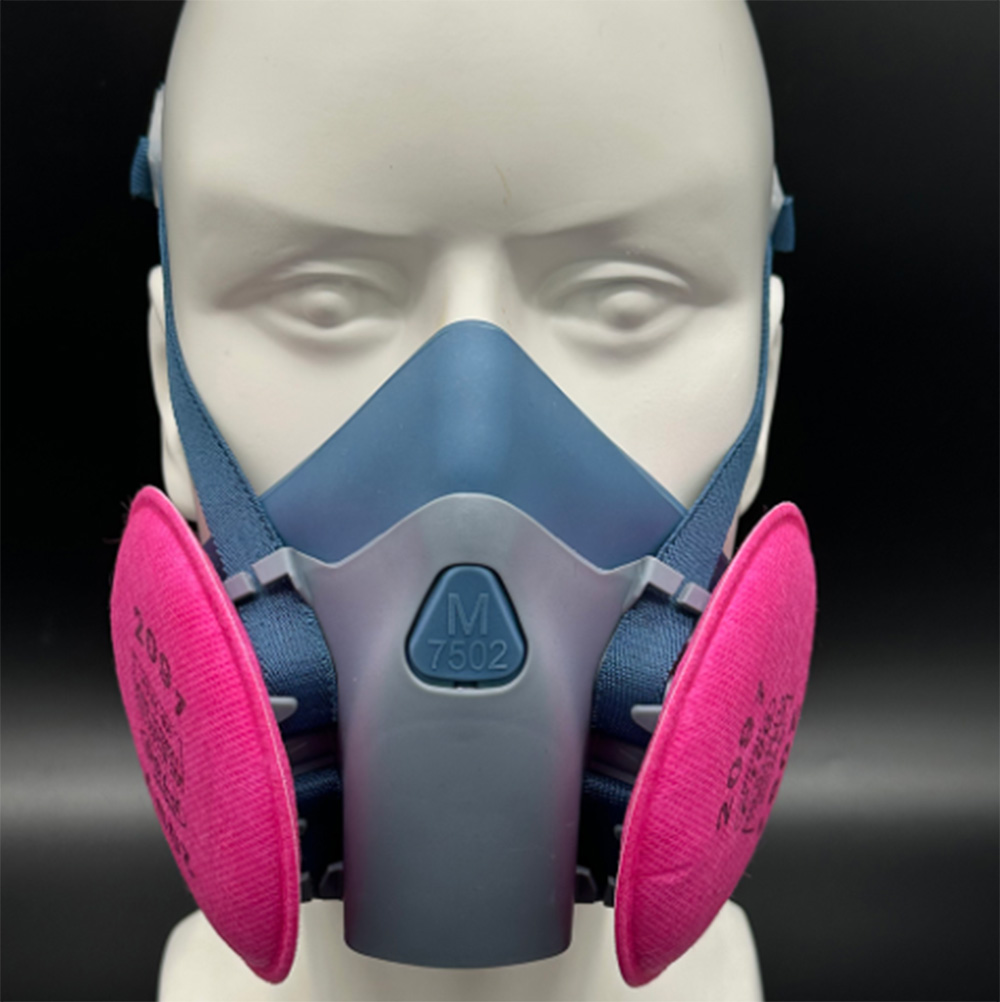
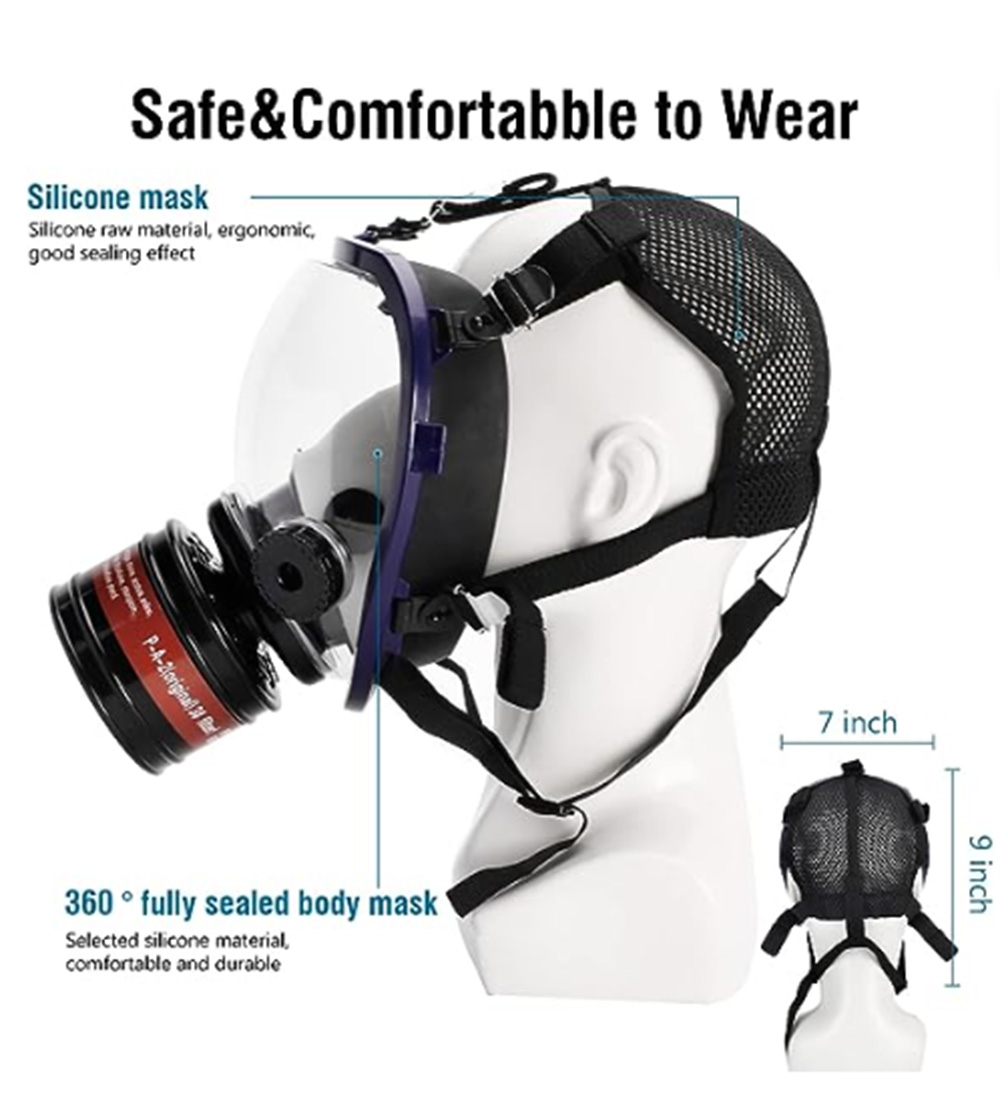
A full facepiece respirator can have the most advanced filters, the clearest visor, and the most comfortable head harness. But if it is the wrong size, it provides zero protection.
Unlike a hard hat or safety glasses—which offer some protection even if slightly too large or small—a tight-fitting respirator depends on a perfect seal. Too big, and contaminants leak in around the edges. Too small, and the facepiece distorts, creating gaps or causing painful pressure points that lead workers to remove it.
At Junsee Group, we help customers prepare for fit testing every day. This guide explains how to determine the correct full facepiece size and how to prepare workers for successful fit testing—before the test begins.
A full facepiece seals against the face at five contact points:
| Contact Point | Location | Why It Matters |
|---|---|---|
| Forehead | Across the brow | Upper seal—prevents contaminants from entering from above |
| Temples | Sides of forehead | Lateral stability and seal |
| Cheeks | Both sides of nose/mouth | Main sealing surface |
| Chin | Below lower lip | Lower seal—prevents contaminants from entering from below |
| Nose bridge | Over the nose | Critical seal point—common leak area |
If the respirator is too large:
| Symptom | Consequence |
|---|---|
| Facepiece slips down on face | Lower seal may open; visor may not align with eyes |
| Chin cup does not contact chin | Gap allows contaminants to enter from below |
| Forehead seal gaps | Contaminants enter from above |
| Head harness must be over-tightened | Uncomfortable; worker removes respirator |
If the respirator is too small:
| Symptom | Consequence |
|---|---|
| Facepiece stretches or distorts | Material deformation creates leak paths |
| Pressure points on nose bridge, chin, or forehead | Pain; worker removes respirator |
| Visor too close to eyes | Restricted vision; fogging issues |
| Chin cup rides up under chin | Unstable seal; discomfort |
✅ Junsee Group takeaway: Correct sizing is not optional—it is the foundation of effective respiratory protection. A worker cannot "make do" with the wrong size.
Most full facepiece manufacturers offer multiple sizes. The most common sizing systems are:
| Size | Typical Fit For |
|---|---|
| Small | Smaller face shapes; narrower faces; lower nose bridges |
| Medium | Average adult faces (fits approximately 60-70% of the population) |
| Large | Larger face shapes; wider faces; higher nose bridges |
| Size | Typical Fit For |
|---|---|
| Small/Medium | Smaller to average adult faces |
| Medium/Large | Average to larger adult faces |
One size claims to fit all. In practice, universal fit often fits few workers well and many workers poorly.
✅ Junsee Group recommendation: Choose a manufacturer that offers at least three sizes (S, M, L) . This gives you the best chance of fitting a diverse workforce.
Before formal fit testing, you can perform preliminary sizing to narrow down which size a worker should try first.
| Step | Action | What to Look For |
|---|---|---|
| 1 | Have worker remove glasses, hats, and any headwear | — |
| 2 | Select a size based on general appearance (start with Medium for most adults) | — |
| 3 | Loosen all head harness straps completely | — |
| 4 | Place the facepiece on the face, chin in chin cup first | — |
| 5 | Pull the head harness over the head (do not tighten yet) | — |
| 6 | Observe the position of the facepiece on the face | — |
| Observation | Indicates | Action |
|---|---|---|
| Chin cup fits comfortably under chin; nose bridge contacts sealing area | Size may be correct | Proceed to user seal check or formal fit testing |
| Facepiece too high (visor above eyes) | Size too small | Try next larger size |
| Facepiece too low (visor below eyes; chin cup above chin) | Size too large | Try next smaller size |
| Gaps at temples or cheeks | Size too large | Try next smaller size |
| Facepiece stretches; white stress marks appear | Size too small | Try next larger size |
| Worker feels pressure on nose bridge before straps are tightened | Size too small | Try next larger size |
| Facepiece slips down immediately when straps are loosened | Size too large | Try next smaller size |
| Worker Characteristic | Starting Size |
|---|---|
| Small female, narrow face, low nose bridge | Small |
| Average female, average male | Medium |
| Large male, wide face, high nose bridge | Large |
| Asian or other populations with lower nose bridges (on average) | May need Small or Medium with better nose bridge design |
| Workers with prominent chins or angular features | May need larger size for chin clearance |
✅ Junsee Group tip: Always start with Medium for average adults. It fits the largest percentage of the population. Then adjust up or down based on preliminary fit observations.
Before formal fit testing, workers should perform a user seal check each time they don the respirator. This is not a substitute for fit testing—but it helps identify gross sizing mismatches.
| Step | Action |
|---|---|
| 1 | Don the respirator and adjust straps for a comfortable fit |
| 2 | Cover the exhalation valve with the palm of your hand |
| 3 | Exhale gently into the facepiece |
| 4 | Feel for pressure buildup inside the facepiece |
| 5 | Listen for air leaks (hissing sounds) |
| Result | Indicates |
|---|---|
| Facepiece bulges slightly; no air leaks felt or heard | Good seal—proceed to negative pressure check |
| Air leaks felt around seal | Poor fit—adjust straps or try different size |
| No pressure buildup | Exhalation valve may be faulty or major leak present |
| Step | Action |
|---|---|
| 1 | After positive pressure check, cover both filter cartridges with palms |
| 2 | Inhale gently to create negative pressure inside facepiece |
| 3 | Hold breath for 5-10 seconds |
| 4 | Observe if facepiece collapses slightly against face |
| 5 | Listen for air leaks (hissing sounds) |
| Result | Indicates |
|---|---|
| Facepiece collapses and stays collapsed; no air leaks | Good seal |
| Facepiece collapses slowly; minor hiss | Minor leak—adjust straps or check valve |
| Facepiece does not collapse; air enters through seal | Poor fit—try different size or model |
⚠️ Important: User seal checks are not a substitute for formal fit testing. OSHA requires annual quantitative or qualitative fit testing. User seal checks are for daily verification only.
Full facepiece respirators require a clean-shaven face where the sealing surface contacts the skin.
| Area | Must Be Clean-Shaven |
|---|---|
| Forehead | Yes |
| Temples | Yes |
| Cheeks | Yes |
| Nose bridge | Yes |
| Chin and under-chin | Yes |
| Jawline | Yes |
| Facial Hair | Allowed? | Why |
|---|---|---|
| Full beard | ❌ No | Hair under the seal line prevents sealing |
| Goatee | ❌ No | Hair on chin and jawline breaks lower seal |
| Mustache (if extends into seal area) | ⚠️ Possibly, if trimmed above the seal line | Most mustaches cross the upper lip seal area—not allowed |
| Stubble (1-3 days growth) | ❌ No | Even short stubble creates leak paths |
| Sideburns (if extend into seal area) | ⚠️ Possibly, if trimmed above the seal line | Most sideburns extend into temple seal area—not allowed |
| Step | Action | Timing |
|---|---|---|
| 1 | Worker must shave all facial hair from the seal area | Day of fit testing (or night before) |
| 2 | Shave closely—stubble is not acceptable | Day of fit testing |
| 3 | Avoid moisturizers, lotions, or oils on the face | Day of fit testing (they can affect seal) |
| 4 | Arrive clean-shaven | Fit testing appointment |
✅ Junsee Group tip: Provide razors and shaving cream at the workplace for workers who arrive with stubble. Many workers do not realize how much stubble (even one day's growth) affects the seal.
Formal fit testing is required by OSHA (29 CFR 1910.134) for all tight-fitting respirators, including full facepieces.
| Test Type | Method | Best For |
|---|---|---|
| Qualitative Fit Testing (QLFT) | Subjective—worker detects test agent (saccharin, bitrex, smoke) | Half masks, full facepieces (less common for full face—sensitivity issues) |
| Quantitative Fit Testing (QNFT) | Objective—instrument measures particle concentration inside vs outside mask | Full facepieces (preferred method) |
Quantitative fit testing uses a PortaCount or similar instrument to measure actual facepiece leakage.
| Preparation Step | Why It Matters |
|---|---|
| Clean-shaven face | Stubble causes leaks that the instrument will detect |
| No moisturizers or lotions | Oils can affect the test agent or seal |
| Respirator clean and dry | Dirty respirators may not seal properly |
| Proper filter cartridges installed | Test requires specific filters (often P100 or N100 for PortaCount) |
| Worker rested (not breathing heavily) | Heavy breathing can affect test results |
| Worker has practiced donning | Inexperienced users often fail due to improper donning |
Qualitative fit testing uses a test agent (saccharin, bitrex, or irritant smoke) that the worker must detect if leakage occurs.
| Preparation Step | Why It Matters |
|---|---|
| Clean-shaven face | Same as QNFT |
| No eating, drinking, or smoking for 15-30 minutes before test | Residual tastes or smells can interfere with test agent detection (especially saccharin/bitrex) |
| No strong perfumes or colognes | Can interfere with test agent detection |
| Worker not allergic to test agent | Check for saccharin allergy (rare) or bitrex sensitivity |
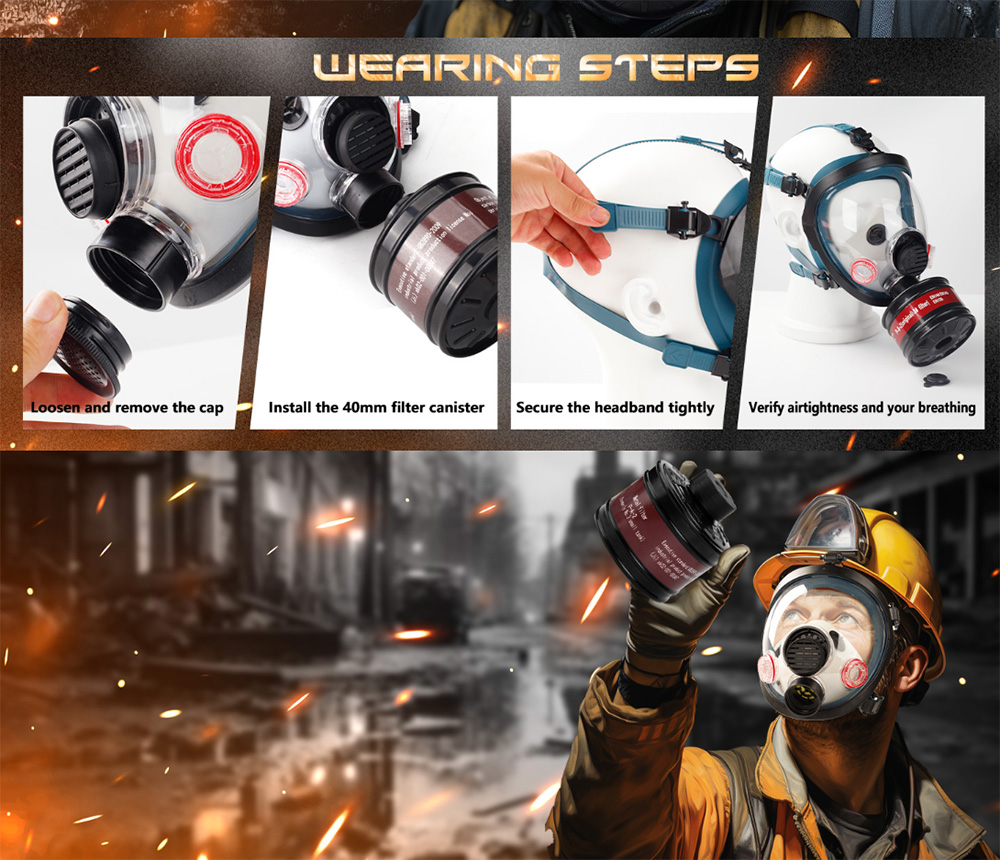
Proper donning is critical for fit testing success. Train workers on this sequence before the test.
| Step | Action | Common Mistakes |
|---|---|---|
| 1 | Remove glasses, hats, headbands, earrings that interfere with seal | Forgetting to remove items |
| 2 | Ensure face is clean-shaven and dry | Stubble or moisture affects seal |
| 3 | Loosen all head harness straps completely | Straps too tight from previous use |
| 4 | Hold the facepiece by the straps or body (not the visor) | Grasping the visor can distort it |
| 5 | Place chin into the chin cup first | Allowing facepiece to ride too high |
| 6 | Pull the head harness over the head (top straps first, then bottom) | Incorrect strap order |
| 7 | Position the facepiece so the visor is centered on the eyes | Crooked facepiece |
| 8 | Tighten lower straps first (evenly, left and right) | Over-tightening one side |
| 9 | Tighten upper straps (evenly, left and right) | Straps too tight or too loose |
| 10 | Perform user seal check (positive and negative pressure) | Skipping the seal check |
| 11 | Adjust as needed—do not over-tighten | Over-tightening distorts facepiece |
| Mistake | Consequence | Correction |
|---|---|---|
| Facepiece too low (visor below eyes) | Lower seal compromised | Reseat with chin in chin cup first |
| Facepiece too high (visor above eyes) | Forehead seal compromised | Reseat with chin in chin cup first |
| Straps uneven (one side tighter than other) | Crooked facepiece; leaks on loose side | Adjust straps evenly |
| Straps over-tightened | Facepiece distortion; leaks; discomfort | Loosen straps—snug is sufficient |
| Hair under seal (sideburns, long hair, ponytail) | Leaks | Pull hair back; ensure seal area clear |
| Glasses worn during donning | Seal broken by temple bars | Remove glasses; use prescription lens inserts |
Despite best preparation, some workers may fail fit testing on a particular model or size.
| Population | Typical First-Time Pass Rate |
|---|---|
| General workforce, properly prepared | 70-85% |
| Workers with diverse face shapes (ethnic diversity, gender diversity) | 60-80% |
| Workers who did not shave adequately | <50% |
| Step | Action |
|---|---|
| 1 | Check preparation: Did worker shave adequately? Is facepiece clean? |
| 2 | Try a different size of the same model |
| 3 | Try a different model from the same manufacturer |
| 4 | Try a different manufacturer entirely |
| 5 | If multiple attempts fail, consider PAPR with loose-fitting hood (no fit testing required) |
✅ Junsee Group tip: Stock at least three sizes and two models of full facepieces. No single model fits everyone.
| Requirement | Detail |
|---|---|
| Initial fit testing | Before first use of any tight-fitting respirator |
| Annual fit testing | At least once every 12 months |
| Re-test triggers | Significant weight change (gain or loss); dental changes; facial surgery; change in respirator model or size |
| Recordkeeping | Must maintain records of fit testing for each worker (model, size, date, results) |
| Field | Example |
|---|---|
| Worker name | John Smith |
| Date of test | June 5, 2026 |
| Respirator model | 3M Full Facepiece 6000 series |
| Size | Medium |
| Fit test method | Quantitative (PortaCount) |
| Fit factor result | 2,500 (pass — required minimum 500 for full facepiece) |
| Tester name | Jane Doe, RST |
| Next test due | June 5, 2027 |
Shave all facial hair from the seal area (forehead, temples, cheeks, chin, jawline)
Avoid heavy moisturizers or lotions on the face
If QLFT (saccharin/bitrex), avoid eating or drinking strong flavors before test
Arrive clean-shaven (no stubble)
Remove glasses, earrings, hats, headbands before donning
Pull long hair back away from seal area
Remove any facial piercings that interfere with seal
Respirator is clean and dry
Correct filter cartridges installed (P100 or N100 for PortaCount QNFT)
Exhalation valve is present and in good condition
Head harness straps are fully loosened
Worker demonstrates correct donning
Worker performs user seal check
Fit test conducted according to protocol (OSHA accepted method)
Results recorded
Assign that specific respirator (model and size) to the worker
Record fit test date and results
Schedule next annual fit test
Provide worker with user seal check training
Try different size of same model
Try different model
Consider PAPR (loose-fitting hood, no fit testing required)
| Key Principle | Why It Matters |
|---|---|
| Start with preliminary sizing | Narrows down which size to try first, saves time |
| Train proper donning | Incorrect donning is the #1 cause of fit test failure |
| Enforce clean-shaven policy | Facial hair makes sealing impossible |
| Stock multiple sizes and models | No single facepiece fits everyone |
| Conduct formal fit testing annually | OSHA requirement; verifies actual protection |
| Document everything | Audit trail for compliance |
The bottom line: Determining the correct full facepiece size is not difficult—but it requires preparation, training, and formal fit testing. Workers cannot guess their size. They cannot "make do" with the wrong size. Take the time to size correctly, train properly, and test annually. Your workers' health depends on it.
At Junsee Group, we provide:
✅ Full facepiece respirators in multiple sizes (S, M, L)
✅ Fit testing guidance and protocol support
✅ Replacement parts (valve flaps, head straps, visors)
✅ Technical support for sizing and selection
Need help preparing for fit testing at your workplace?
Contact Junsee Group today. We will help you determine the right sizes, prepare your workers, and set up a compliant fit testing program.


Your email address will not be published. Required fields are marked