
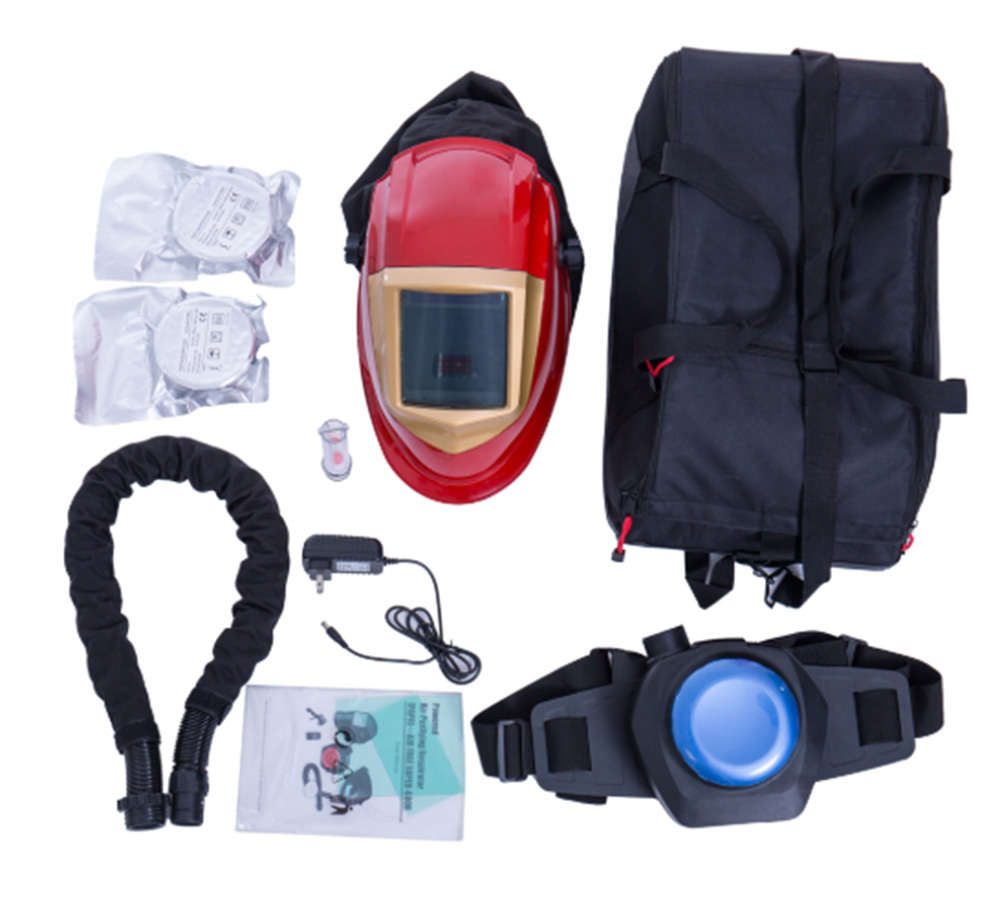
Buying a Powered Air Purifying Respirator (PAPR) is a significant investment. With systems ranging from 2,000 per unit, you want to get it right.
But here is the problem: many safety managers focus on the wrong things. They compare battery specifications while ignoring filter compatibility. They look at price while overlooking protection factor. And they end up with a PAPR system that workers hate – or worse, one that does not provide adequate protection.
At Junsee Group, we have helped hundreds of customers select PAPR systems. We have seen every mistake. And we have distilled the selection process down to 5 key parameters that you must evaluate before buying.
Ignore any of these, and you risk wasting money – or compromising worker safety.
This is the most important parameter – and the most commonly misunderstood.
What it is: The Assigned Protection Factor (APF) is the level of protection a respirator is expected to provide. An APF of 50 means the contaminant concentration inside the respirator is 1/50th of the concentration outside.
Why it matters: If your workplace hazard has an airborne concentration that is 50 times the permissible exposure limit (PEL), you need a respirator with an APF of at least 50. A lower APF means inadequate protection.
| PAPR Configuration | Typical APF | Best For |
|---|---|---|
| Loose-fitting hood/helmet (EN 12941 TH1) | 10-25 | Low hazard, nuisance dust |
| Loose-fitting hood/helmet (EN 12941 TH2) | 25-50 | General industrial, moderate hazards |
| Loose-fitting hood/helmet (EN 12941 TH3) | 1000+ | High toxicity, pharmaceuticals, healthcare |
| Tight-fitting full facepiece (EN 12942) | 50-1000 | Chemical splash, higher protection need |
| Tight-fitting half mask (EN 12942) | 20-50 | When hood is impractical |
Mistake: Buying a PAPR system without checking its APF rating relative to your hazard concentration.
Example: A factory with lead dust at 30x the PEL buys a TH1 PAPR (APF ~10). The PAPR provides inadequate protection – workers are still overexposed.
Junsee Group advice: Calculate your required APF before shopping: Required APF = Airborne concentration ÷ Permissible exposure limit (PEL). Then choose a PAPR with an APF at least that high – and preferably higher.
✅ Best practice: For unknown or variable hazards, choose TH3 (APF 1000+) – the highest protection available.
Airflow rate determines how comfortable the PAPR feels – and whether it can maintain positive pressure during heavy breathing.
What it is: The volume of air delivered by the blower to the headpiece, measured in cubic feet per minute (CFM) or liters per minute (L/min).
Why it matters: Too little airflow, and you feel like you are not getting enough air – you may even experience negative pressure during heavy exertion. Too much airflow (rare), and you may feel a draft or hear excessive noise.
| Standard | Minimum Airflow |
|---|---|
| NIOSH (US) | 115 L/min (4 CFM) minimum, 170 L/min (6 CFM) typical |
| EN 12941/12942 (Europe) | 120-200 L/min depending on class |
| Comfortable range for most workers | 170-220 L/min (6-8 CFM) |
| Work Intensity | Recommended Airflow | Why |
|---|---|---|
| Light (office, laboratory) | 115-150 L/min | Lower airflow is acceptable |
| Moderate (assembly, walking) | 150-185 L/min | Need more air to maintain positive pressure |
| Heavy (welding, construction, climbing) | 185-220+ L/min | High breathing rate requires higher airflow |
Mistake: Buying a PAPR with low airflow to save money on battery life (higher airflow drains batteries faster).
Example: A PAPR with 115 L/min airflow feels fine in the office but leaves a welder gasping for air during heavy work. The worker removes the hood to breathe better – losing all protection.
Junsee Group advice: Match airflow to your highest work intensity, not average. If workers ever perform heavy work, choose a PAPR with 185+ L/min airflow.
✅ Best practice: Look for PAPRs with adjustable airflow – workers can set low for light work and high for heavy tasks.
PAPRs are powered by batteries. When the battery dies, protection stops. This is non-negotiable.
What it is: The runtime of the PAPR battery under normal operating conditions, typically measured in hours.
Why it matters: If a worker's shift is 8 hours but the battery lasts only 6, they will spend the last 2 hours either unprotected or scrambling to swap batteries – interrupting work and risking exposure.
| Work Intensity | Battery Drain | Recommended Minimum Runtime |
|---|---|---|
| Light (low airflow setting) | Low | 10-12 hours (covers shift + buffer) |
| Moderate (medium airflow) | Medium | 8-10 hours (minimum full shift) |
| Heavy (high airflow) | High | 6-8 hours (may need spare battery) |
| Battery Type | Pros | Cons |
|---|---|---|
| Lithium-ion (Li-ion) | Lightweight, high energy density, no memory effect | More expensive, requires proper disposal |
| Nickel-metal hydride (NiMH) | Lower cost, less hazardous disposal | Heavier, shorter runtime, memory effect |
| Sealed lead acid (SLA) | Low cost | Very heavy, short cycle life – rarely used in modern PAPRs |
Mistake: Assuming published battery life applies to your actual work conditions.
Example: A PAPR advertises "10-hour battery life" – but that is measured at low airflow (115 L/min) in a 20°C environment. In a 35°C foundry with high airflow (200 L/min), runtime drops to 5 hours.
Junsee Group advice:
Buy batteries rated for 1.5x your longest shift (e.g., 12 hours for an 8-hour shift)
Look for hot-swappable batteries – workers can change batteries without removing the PAPR
Consider spare battery kits – one spare per 2-3 workers ensures continuous coverage
✅ Best practice: Choose PAPRs with battery fuel gauges – workers can see remaining runtime and swap batteries proactively, not after shutdown.
You are buying a PAPR system, not just a blower. The blower is useless without compatible filters for your specific hazards.
What it is: The range and type of filters (particulate, gas, combination) that work with the PAPR blower.
Why it matters: A PAPR that cannot accept gas cartridges is useless in a chemical environment. A PAPR with only proprietary filters locks you into expensive, single-source consumables.
| Question | Why It Matters |
|---|---|
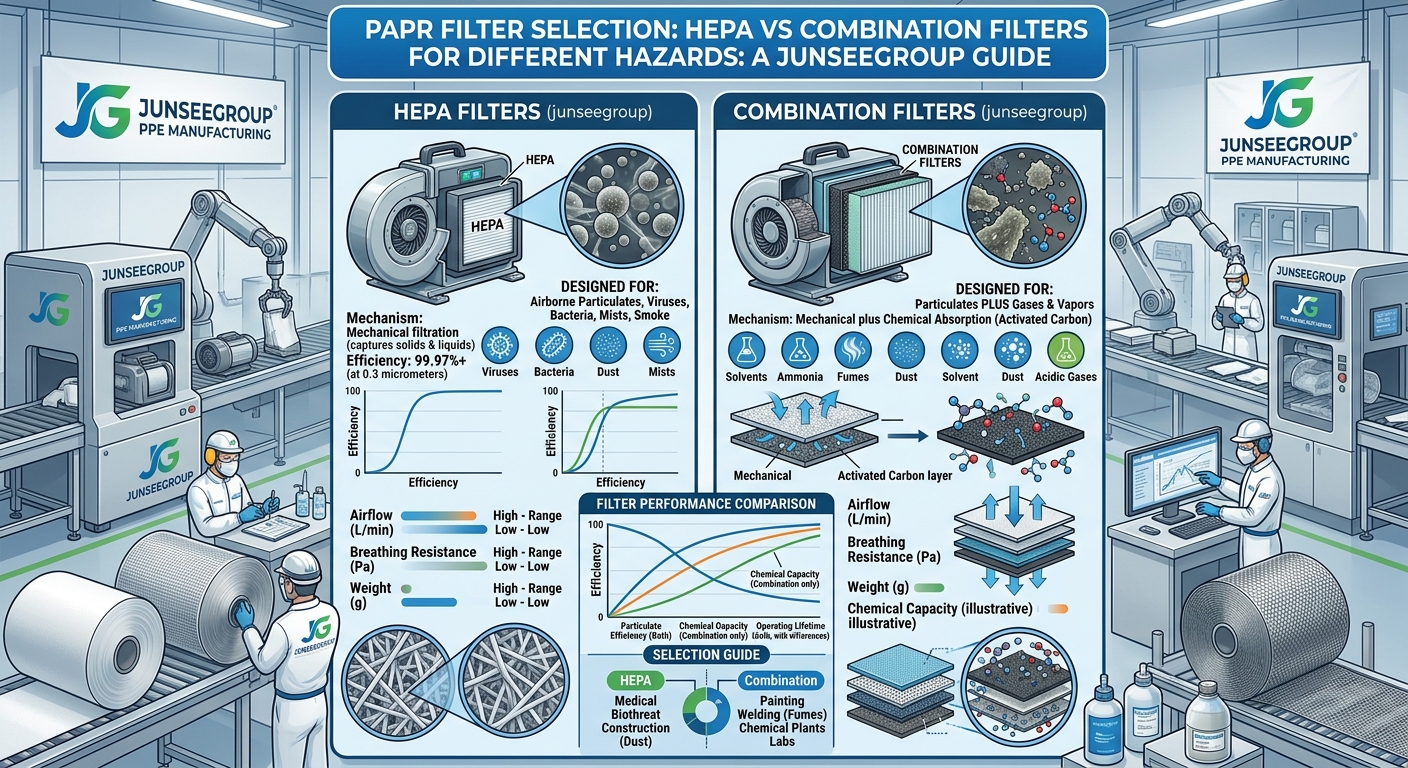
| Does the PAPR accept particulate filters (HEPA, TH2, TH3)? | Needed for dust, fumes, mists, bioaerosols |
| Does the PAPR accept gas cartridges? | Needed for solvents, acids, ammonia, chemical vapors |
| Does the PAPR accept combination filters? | Needed for mixed hazards (dust + gas) |
| Are filters proprietary or standardized? | Proprietary filters may be expensive and hard to source |
| Is there a pre-filter option? | Extends main filter life in dusty environments |
Mistake: Buying a PAPR designed only for particulates when your workplace has gas hazards.
Example: A pharmaceutical plant buys a healthcare PAPR system (particulate-only) for a solvent blending operation. Workers are exposed to organic vapors because the system has no gas cartridges.
Another common pitfall: Assuming all PAPR filters are interchangeable. They are not.
| PAPR Brand | Filter Compatibility | Lock-in Risk |
|---|---|---|
| Some manufacturers | Proprietary filters only – other brands do not fit | High – must buy from same brand |
| Others | Accept standardized bayonet or threaded filters | Low – can source from multiple suppliers |
Junsee Group advice:
First, identify your hazards – particulates, gases, or both?
Then, verify the PAPR you are considering supports the required filter types
Check pre-filter availability – essential for dusty environments
Consider filter sourcing – proprietary filters create supply chain risk
✅ Best practice: Choose PAPRs that accept standardized filter connections (e.g., bayonet or 40mm threaded) to avoid vendor lock-in.
The most protective PAPR in the world provides zero protection if workers leave it in the locker because it is uncomfortable.
What it is: How the PAPR feels during actual use – weight distribution, headpiece design, noise level, and compatibility with other PPE.
Why it matters: Comfort drives compliance. Uncomfortable PAPRs get modified, removed, or abandoned. Comfortable PAPRs become part of the worker's daily routine.
| Factor | What to Check | Common Pitfall |
|---|---|---|
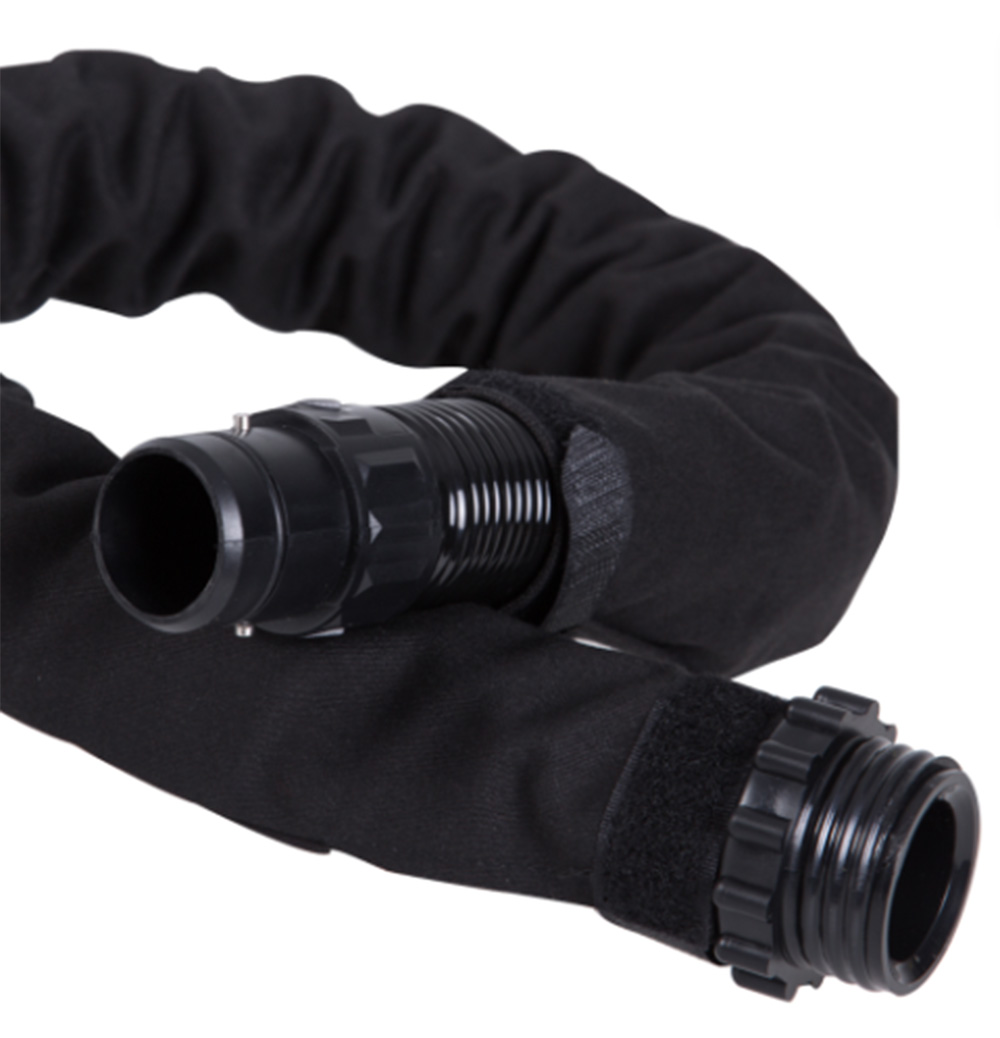
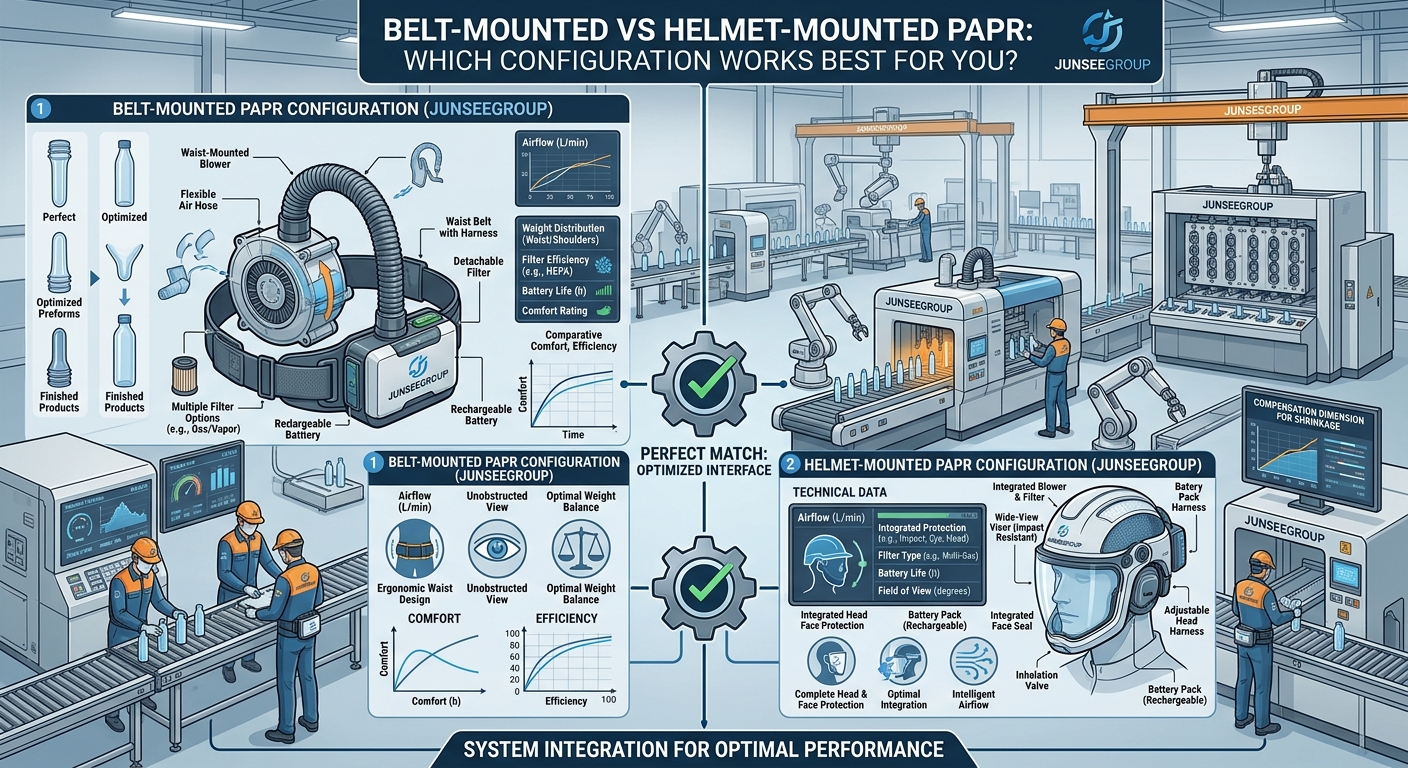
| Weight distribution | Is the blower belt-mounted (weight on hips) or helmet-mounted (weight on head)? | Helmet-mounted systems cause neck fatigue on long shifts |
| Headpiece design | Does the hood or helmet fit over hard hats? Does it seal comfortably? | Improper fit leads to workers loosening headgear – compromising protection |
| Noise level | How loud is the blower at the ear? | Loud PAPRs cause worker fatigue and communication problems |
| Visibility | Is the visor wide enough? Does it fog? | Poor visibility leads to accidents – and workers removing the hood |
| Compatibility with other PPE | Can workers wear safety glasses, hearing protection, hard hats? | Incompatible PPE means workers must choose – often choosing the wrong option |
| Donning and doffing ease | How long does it take to put on correctly? | Complex systems lead to incorrect use – or no use at all |
Mistake: Buying a PAPR based on specifications without having workers try it on.
Example: A safety manager buys a helmet-mounted PAPR for an 8-hour shift because it looks rugged and professional. Workers complain of neck pain after week one. Compliance drops to 40%.
Another common pitfall: Ignoring compatibility with other required PPE.
Example: A PAPR hood that does not fit over a hard hat forces workers to choose: head protection or respiratory protection. They cannot have both. This is unacceptable.
Junsee Group advice:
Trial before you buy – have 5-10 workers wear the PAPR for a full shift
Ask specific questions: "Does it feel heavy after 4 hours?" "Can you wear your safety glasses comfortably?" "Is the noise bothersome?"
Test compatibility with all other PPE workers must wear
Consider belt-mounted for long shifts – weight on hips, not head
✅ Best practice: Run a PAPR pilot program with 2-3 different models before making a large purchase. Let workers vote on comfort. They are the ones wearing it every day.
| Parameter | What to Check | Red Flag | Green Flag |
|---|---|---|---|
| 1. Protection Factor (APF) | Is APF adequate for your hazard concentration? | APF < required by hazard | APF ≥ hazard concentration ÷ PEL |
| 2. Airflow Rate | Is airflow sufficient for highest work intensity? | <150 L/min for heavy work | ≥185 L/min for heavy work |
| 3. Battery Life | Does runtime cover longest shift + buffer? | Runtime < shift length | Runtime ≥ 1.5x shift length |
| 4. Filter Compatibility | Does PAPR accept filters for your hazards? | Particulate-only for gas hazards | Accepts particulate, gas, and combination filters |
| 5. Comfort & Fit | Will workers wear it all shift? | No trial before purchase | Workers tested and approved |
Before you buy any PAPR, run through this checklist:
Have you identified all airborne hazards (particulates, gases, or both)?
Have you measured or estimated hazard concentration?
Have you calculated required APF (hazard ÷ PEL)?
Have you determined work intensity (light, moderate, heavy)?
Have you measured longest shift duration?
Have you identified all other required PPE (hard hat, glasses, hearing, fall protection)?
Does PAPR APF meet or exceed required APF?
Does airflow meet or exceed recommended rate for work intensity?
Does battery life exceed shift duration by at least 20%?
Does PAPR accept required filter types (particulate, gas, combination)?
Have workers tested the PAPR for a full shift?
Is the PAPR compatible with all other PPE?
Are replacement filters and batteries readily available?
Have all workers received training on proper use?
Have you established a filter and battery replacement schedule?
Do you have spare batteries and filters in stock?
At Junsee Group, we do not just sell PAPR systems – we help you select the right PAPR system for your specific workplace.
We provide:
✅ Hazard assessment support – Identify what is in your air
✅ APF calculation – Determine required protection level
✅ Product recommendations – Based on your work intensity, shift length, and other PPE
✅ Pilot program assistance – Test before you commit
✅ Training materials – For proper use and maintenance
✅ Ongoing technical support – Long after the sale
The bottom line: Selecting a PAPR is not about finding the cheapest unit or the one with the longest battery life. It is about matching the right 5 key parameters to your specific hazards, workers, and work environment. Get these right, and your PAPR program will succeed. Get one wrong, and you waste money – or worse, compromise worker safety.

Your email address will not be published. Required fields are marked